
Mathematical discovery at CIRS
Math Challenge
For minds that look beyond the obvious.
Explore your division View results archive Try the cube puzzle
Four divisions, one love of mathematics.
A different way to think.
Every problem is an invitation to discover a new way of thinking.
Try it yourself · No timer
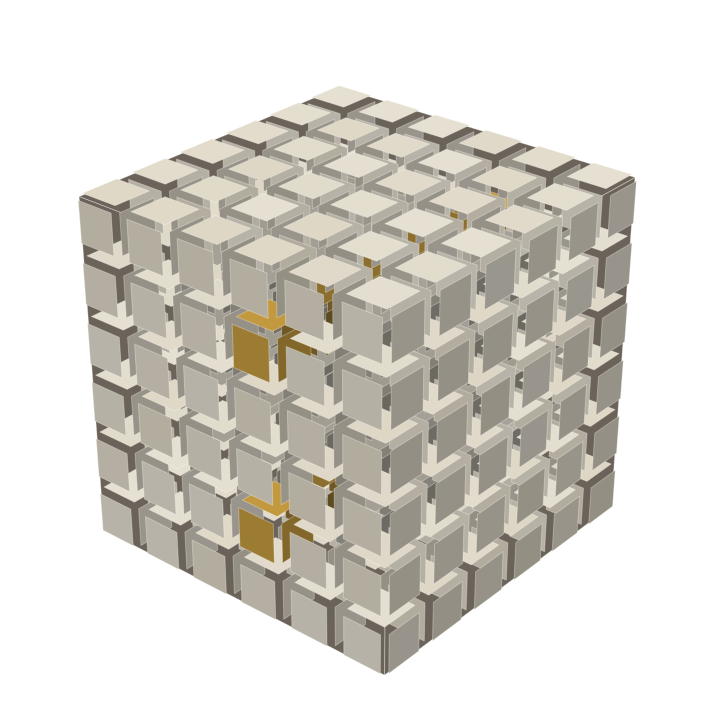
Build your way to 1729.
Find two different pairs of positive whole numbers whose cubes each add up to 1729. Change an edge and watch its volume grow.
2³ + 3³ = 35
0 of 2 pairs found
Your discoveries will appear here.
Based on the December 2016 newsletter example. Read the full worked solution.
From the CIRS mathematics newsletter
One number.
Two ways to see it.
Explore the two cube decompositions of 1729 shown in the school’s December 2016 newsletter, printed page 1.
Show full solutionCan the same number be a sum of two positive cubes in two different ways?
Find two pairs of positive integers.
1³ + 12³ = 9³ + 10³ = 1729
A complete solution
01. The problem
Find a number that can be expressed as two different sums of two positive cubes.
02. Build the cubes
Try the pairs (1, 12) and (9, 10). A cube with side n has volume n³.
03. Calculate each pair
1³ = 1 and 12³ = 1728, so their sum is 1729.
9³ = 729 and 10³ = 1000, so their sum is also 1729.04. Verify the equality
Both pairs contain different positive integers, and both give the same sum.
Four grade divisions
Find your challenge.
The challenge runs in four divisions, from Grade 5 to Grade 12. Explore each division and its published results. Try the newsletter’s 1729 cube challenge above.
Division 01
Grades 5–6
Number sense, pattern and logic — problems that reward noticing rather than calculating quickly.
Grade-specific problem sets have not been supplied. The published documents below announce winners.
Explore the 1729 cube challenge →Published results
- April 2026Winners’ bulletin · PDF · 1.3 MB ↗
- February 2026Winners’ bulletin · PDF · 1.2 MB ↗
- January 2026Winners’ bulletin · PDF · 1.0 MB ↗
- October 2025Winners’ bulletin · PDF · 1.4 MB ↗
- September 2025Winners’ bulletin · PDF · 1.4 MB ↗
- August 2025Winners’ bulletin · PDF · 1.2 MB ↗
- July 2025Winners’ bulletin · PDF · 476 KB ↗
Division 02
Grades 7–8
Reasoning stretched further: relationships, geometry and the kind of puzzle that needs a plan before a pencil.
Grade-specific problem sets have not been supplied. The published documents below announce winners.
Explore the 1729 cube challenge →Published results
- April 2026Winners’ bulletin · PDF · 587 KB ↗
- February 2026Winners’ bulletin · PDF · 578 KB ↗
- January 2026Winners’ bulletin · PDF · 2.4 MB ↗
- October 2025Winners’ bulletin · PDF · 1.1 MB ↗
- September 2025Winners’ bulletin · PDF · 2.7 MB ↗
- August 2025Winners’ bulletin · PDF · 3.1 MB ↗
- July 2025Winners’ bulletin · PDF · 1.3 MB ↗
Division 03
Grades 9–10
Problems that ask a student to connect ideas from different parts of the syllabus, and to justify the connection.
Grade-specific problem sets have not been supplied. The published documents below announce winners.
Explore the 1729 cube challenge →Published results
- April 2026Winners’ bulletin · PDF · 785 KB ↗
- January 2026Winners’ bulletin · PDF · 1.4 MB ↗
- October 2025Winners’ bulletin · PDF · 605 KB ↗
- September 2025Winners’ bulletin · PDF · 987 KB ↗
- August 2025Winners’ bulletin · PDF · 1.3 MB ↗
- July 2025Winners’ bulletin · PDF · 707 KB ↗
Division 04
Grades 11–12
Sustained problems of the sort that reward a whole evening, and the habits of mind that higher study asks for.
Grade-specific problem sets have not been supplied. The published documents below announce winners.
Explore the 1729 cube challenge →Published results
- April 2026Winners’ bulletin · PDF · 495 KB ↗
- January 2026Winners’ bulletin · PDF · 1.2 MB ↗
- September 2025Winners’ bulletin · PDF · 706 KB ↗
- August 2025Winners’ bulletin · PDF · 1.8 MB ↗
- July 2025Winners’ bulletin · PDF · 463 KB ↗
Published winners’ bulletins
The results archive.
Month by month, the mathematics department publishes a bulletin naming each division’s winners. Every bulletin published so far is listed here, newest first. Where a division has no bulletin for a month, none is listed.
25 bulletins across 7 months
April 2026
Grades 7–8
Winners’ bulletin April 2026 Open PDF 587 KBGrades 9–10
Winners’ bulletin April 2026 Open PDF 785 KBGrades 11–12
Winners’ bulletin April 2026 Open PDF 495 KBFebruary 2026
Grades 5–6
Winners’ bulletin February 2026 Open PDF 1.2 MBGrades 7–8
Winners’ bulletin February 2026 Open PDF 578 KBJanuary 2026
Grades 5–6
Winners’ bulletin January 2026 Open PDF 1.0 MBGrades 7–8
Winners’ bulletin January 2026 Open PDF 2.4 MBGrades 9–10
Winners’ bulletin January 2026 Open PDF 1.4 MBGrades 11–12
Winners’ bulletin January 2026 Open PDF 1.2 MBOctober 2025
Grades 5–6
Winners’ bulletin October 2025 Open PDF 1.4 MBGrades 7–8
Winners’ bulletin October 2025 Open PDF 1.1 MBGrades 9–10
Winners’ bulletin October 2025 Open PDF 605 KBSeptember 2025
Grades 5–6
Winners’ bulletin September 2025 Open PDF 1.4 MBGrades 7–8
Winners’ bulletin September 2025 Open PDF 2.7 MBGrades 9–10
Winners’ bulletin September 2025 Open PDF 987 KBGrades 11–12
Winners’ bulletin September 2025 Open PDF 706 KBAugust 2025
Grades 5–6
Winners’ bulletin August 2025 Open PDF 1.2 MBGrades 7–8
Winners’ bulletin August 2025 Open PDF 3.1 MBGrades 9–10
Winners’ bulletin August 2025 Open PDF 1.3 MBGrades 11–12
Winners’ bulletin August 2025 Open PDF 1.8 MBJuly 2025
Grades 5–6
Winners’ bulletin July 2025 Open PDF 476 KBGrades 7–8
Winners’ bulletin July 2025 Open PDF 1.3 MBGrades 9–10
Winners’ bulletin July 2025 Open PDF 707 KBGrades 11–12
Winners’ bulletin July 2025 Open PDF 463 KBNo published bulletins match.
Try another month or year, or show every division.
Five stages
How a mind solves.
-
Question
Read it twice. Decide what is actually being asked, and what is only decoration.
-
Think
Look for the pattern, the symmetry, the thing that stays the same while everything else moves.
-
Explore
Try the small case. Draw it. Guess, then test the guess and find out why it failed.
-
Solve
Build the argument step by step, and check that each step follows from the one before it.
-
Discover
Ask what the problem was really about — that is the part that carries to the next one.
Under construction
This page is still being written. Photographs, names and figures marked in brackets are placeholders awaiting the school, and more will be added here in the weeks ahead. Tell us what is missing.