
The Crossroads Issue 33
The Western Canonization of Satyajit Ray
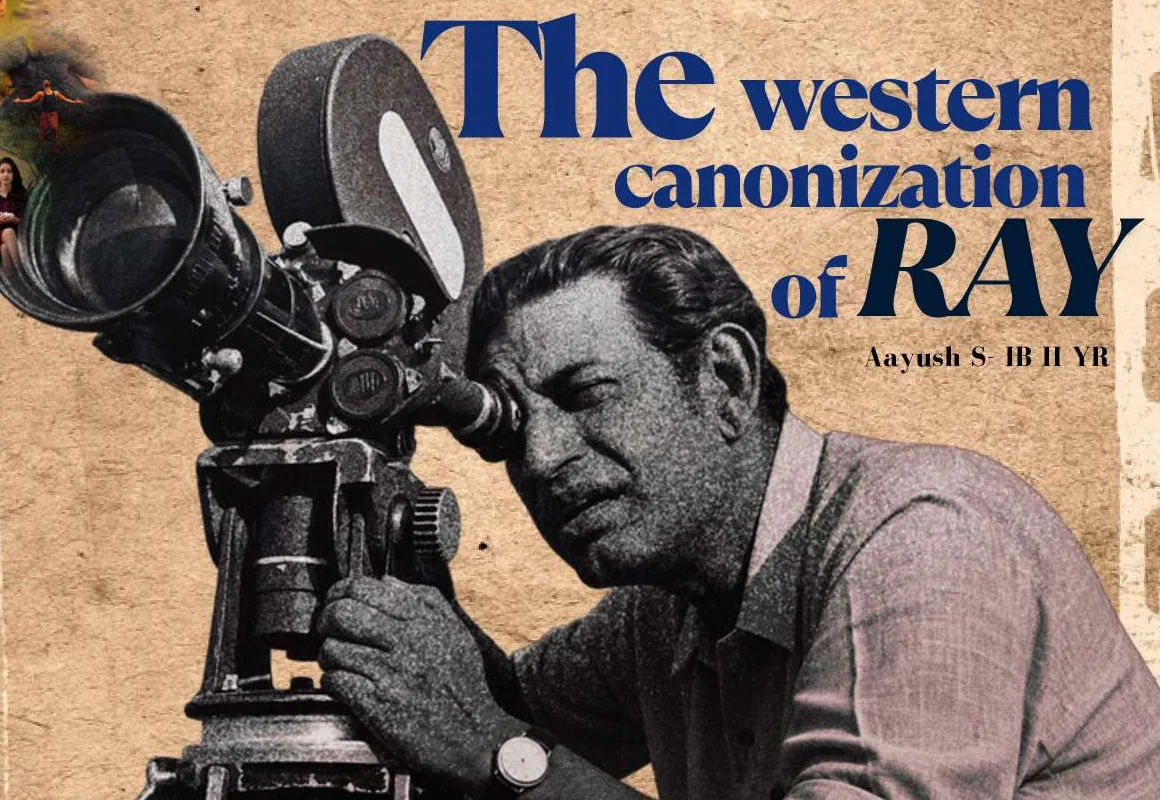
There is a peculiar ritual that occurs whenever Indian cinema enters a Western conversation about “world cinema”: someone says Satyajit Ray’s name, and the conversation more or less ends there. He becomes the shorthand, acceptable, legible face of an entire nation’s cinema spanning dozens of languages, regions, themes, and ideological positions. Kurosawa gets to represent Japan while still leaving room for Ozu, Mizoguchi, and Naruse; Sweden has Bergman, yet Sjöström and Widerberg are still part of the picture. But Ray is regularly asked to represent India alone, as if Ritwik Ghatak, Mrinal Sen, and a dozen others aren’t relevant. This so-called “minor curatorial oversight” overshadows the astute pattern in canon formations that disguise themselves as accidents, but in actuality reveal what the canonizing culture is really looking for.
Ray’s international ascent began with the Apu Trilogy’s reception at Cannes and MoMA in the mid-1950s, and it’s worth asking what made his work so immediately exportable when the work of his counterparts was not. What I’ve come to realize is that the answer lies in a greater depth than mere quality. Ghatak’s Meghe Dhaka Tara and Sen’s Bhuvan Shome are by most serious critical measures every bit as accomplished, so it couldn’t be that… the true depth lies more in legibility. What I mean by this is Ray’s Humanism, his Renoir-inflected visual grammar, his interest in individual psychological interiority, all charted comfortably and conveniently onto categories Western critics already possessed. He could be discussed using the same vocabulary applied to Italian neorealism or the more humanist strands of European art cinema. His films offered Western audiences a version of poverty and rural life that was legible as universal, sorrowful, dignified, and perhaps apolitical enough to be received as “human” rather than as statements.
Ghatak’s work, by contrast, is openly disruptive in ways that resist most easy translation. His employment of sound, theatrical excess, and his denial of adopting psychological realism in favor of something closer to melodrama-as-political-rupture, were choices rooted specifically in the trauma of Partition and the Bengali refugee experience. They require a viewer fluent in that specific history and willing to acknowledge a film that doesn’t smooth its anger into something palatable. Ghatak’s brusque disinterest in legibility to audiences in Paris or New York is what cost him the canonization Ray received, showing that his films were no lesser than Ray’s; they just weren’t designed for export.
In hindsight, the argument worth making suggests the view that the Western art-cinema apparatus of the 1950s through 1970s (festival juries, distributors, the critical establishment writing for outlets) was not neutrally scanning the world for the “best” films. It was rather selecting a particular kind of Humanism, to be more specific, the one compatible with a post-war European sensibility that wanted to affirm universal human dignity while carefully avoiding films that indicated colonialism, caste, or the economic structures Western capital still benefited from. Ray’s humanism is no doubt real and considerable, but it is also, not coincidentally, the version of Indian suffering least likely to implicate the viewer.
Mrinal Sen, though, fully understood this very dynamic and pushed directly against it. His later work, particularly through the 1970s, is explicitly Marxist, and often hostile to the very idea of the sympathetic bourgeois gaze that made Ray so consumable. What made Sen a harder sell to a festival circuit was his belief in the use of the camera as a tool for accusation, something contradictory to those festivals whose funding and audiences were themselves implicated in the global structures being accused. So, Sen won prizes, but he never became the single word a casual Western cinephile could drop to demonstrate cultural literacy about India.
The deeper we delve, we notice that there’s a broader mechanism at work here that isn’t specific to India. The Western art-cinema canon has historically preferred to admit non-Western cinemas one auteur at a time, as singular geniuses who transcend their national context, rather than as members of a wholly plural film culture. This subtle gameplay is what allows the West to consume difference without doing the harder work of understanding a cinema’s internal debates, as in the arguments Ray, Ghatak, and Sen were actually having with one another about the form, politics and noticeably, the ethics of representing poverty. Reducing that ecosystem to a single representative name flattens a rich critical argument into a single answer, and conveniently, the West got to pick which answer.
This is the same logic that made Kurosawa “Japanese cinema” for a generation of American cinephiles despite his own frequently ambivalent relationship to Japanese critics, who at times considered him too Western in sensibility. The single-genius model is a way of managing non-Western cultural output so it can be absorbed without disrupting the West’s sense of its own centrality as the place where judgment happens.